Module 1 of the Agentic AI Mastery Course by Dr. Ananjan Maiti
The Shift from Reactive AI to Autonomous Intelligence
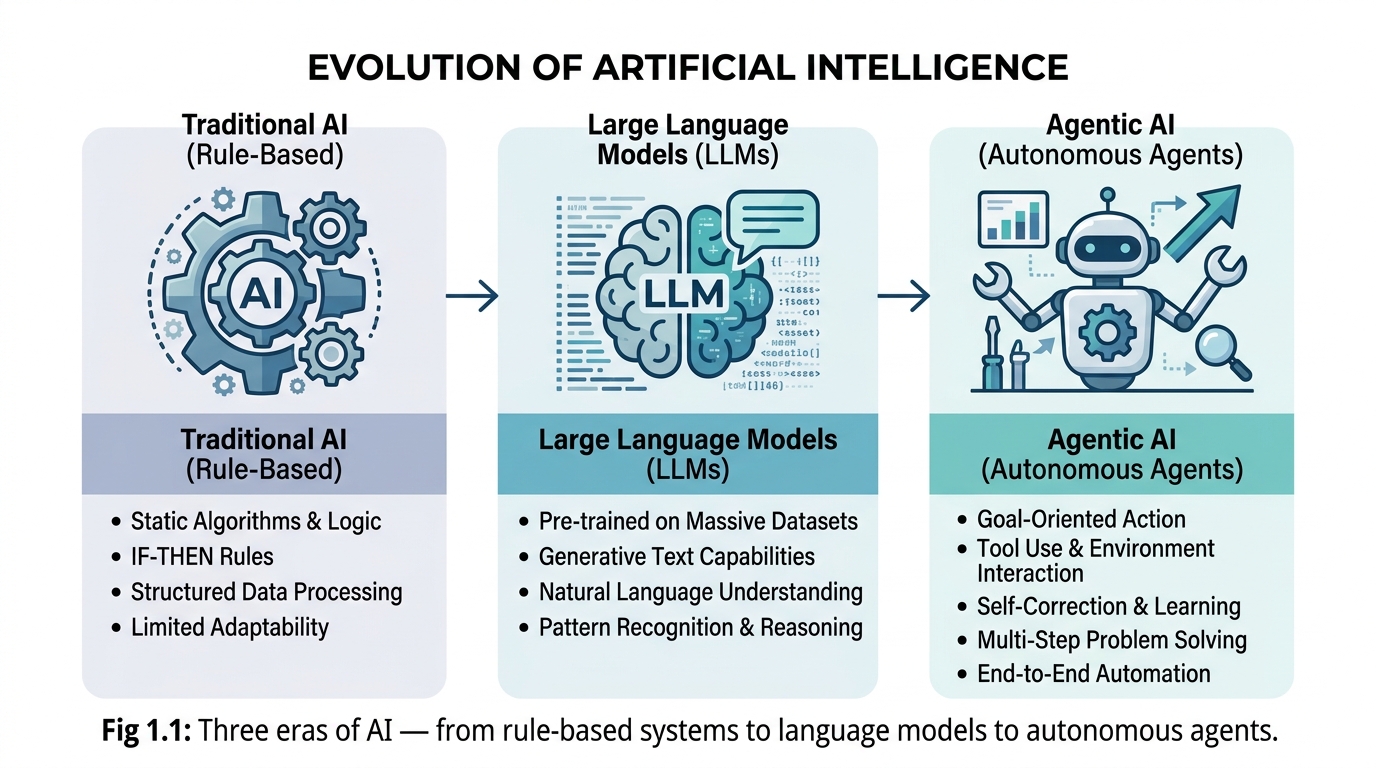
Artificial intelligence has evolved through three distinct phases, each representing a fundamental shift in capability. Understanding this evolution is essential for grasping why agentic AI represents the most significant advancement in applied artificial intelligence since deep learning.
The first phase was traditional AI — narrow, task-specific systems designed to excel at one well-defined function. These include recommendation engines, spam filters, image classifiers, and rule-based expert systems. They are powerful within their domain but entirely incapable of operating outside it.
The second phase introduced large language models — systems like GPT, Claude, Gemini, and LLaMA that understand and generate human language with remarkable fluency. However, LLMs operate on a fundamentally reactive architecture: you provide an input, the model produces an output. There is no planning, no persistent memory, no ability to use external tools, and no capacity to pursue multi-step goals autonomously.
The third phase — where we stand today — is agentic AI. These systems combine the linguistic intelligence of large language models with planning mechanisms, persistent memory, tool integration, and autonomous decision-making. Rather than simply responding to prompts, an agentic AI system receives a goal, decomposes it into subtasks, selects appropriate tools, executes each step, evaluates results, and iterates until the objective is achieved. Generative AI answers questions. Agentic AI solves problems.
What Makes an AI System Agentic?
An AI system qualifies as agentic when it exhibits several interconnected capabilities that together enable autonomous, goal-directed behavior.
Goal-Driven Behavior
Traditional AI systems are instruction-driven — they execute exactly what they are told. Agentic systems are goal-driven — they receive an objective and independently determine the path to achieve it. When you tell an agentic system to prepare a competitive analysis, it identifies companies, gathers data from multiple sources, structures the analysis, and produces a comprehensive deliverable. The system decides how to accomplish the goal, not just what to output.
Autonomy and Decision-Making
Autonomy is the capacity to operate based on goals rather than explicit step-by-step instructions. An agentic system decides which tools to use, when to seek additional information, how to handle errors, and whether the current approach needs adjustment. This autonomy exists on a spectrum — from semi-autonomous systems that request human approval at key decision points to fully autonomous agents that complete entire workflows independently.
Planning and Task Decomposition
Complex goals cannot be achieved in a single step. Agentic AI systems employ planning mechanisms to decompose high-level objectives into sequences of manageable subtasks. This planning can be hierarchical, sequential, or iterative — where the agent continuously refines its approach based on intermediate results. A well-designed agent does not merely execute a fixed plan; it adapts as new information becomes available.
Memory and Context Persistence
Unlike standard language models that treat each interaction independently, agentic systems maintain memory across interactions. Short-term memory holds the context of the current task — the conversation history, intermediate results, and active plan state. Long-term memory stores knowledge accumulated across sessions — user preferences, project history, learned patterns, and domain expertise. This dual memory architecture enables agents to behave like persistent assistants rather than stateless responders.
Tool Use and External Integration
One of the most transformative capabilities of agentic AI is the ability to interact with external tools and systems. An agentic system can search the internet, query databases, execute code, call APIs, read documents, send emails, manage calendars, and interact with virtually any digital system. This tool-use capability transforms the agent from a text generator into an action-taking system that produces real-world outcomes.
The Agentic Loop: How AI Agents Think and Act
At the heart of every agentic AI system lies a fundamental operational pattern known as the agentic loop. This loop defines how the agent processes tasks and is the architectural backbone of all modern agent frameworks.
The loop follows a cycle: Perceive → Reason → Plan → Act → Observe → Reflect → Repeat. The agent first perceives the current state — the user’s request, available context, and environmental information. It then reasons about what needs to happen, creates or updates a plan, takes action using available tools, observes the result of that action, reflects on whether the outcome advances the goal, and either continues with the next step or adjusts its approach.
This pattern is formalized in the ReAct framework (Reasoning and Acting), which structures the agent’s internal process as an alternating sequence of thought and action. The agent generates a reasoning trace explaining its current thinking, then selects and executes an action, then observes the result, then reasons again. This explicit reasoning process makes the agent’s behavior more transparent and debuggable compared to black-box approaches.
Example: An Agentic Travel Planning System
Consider telling an agentic system: “Plan a three-day trip to Japan under fifteen hundred dollars.” A standard language model would generate suggestions — places to visit, travel tips, hotel recommendations. An agentic system would go far beyond this. It would search for flights across multiple airlines, compare hotel prices within budget constraints, build a complete day-by-day itinerary, verify availability, calculate total costs, adjust the plan if the budget is exceeded, and present a finalized travel plan with booking links. The difference is not just in quality of output — it is in the fundamental nature of the interaction. The agent performs the task rather than describing how it might be performed.
Agentic AI vs. Generative AI: A Clear Comparison
Understanding the distinction between agentic and generative AI is critical for professionals entering this field. These are not competing paradigms but complementary layers of capability.
Interaction model: Generative AI is prompt-based — you ask a question, the AI gives a response. Agentic AI is goal-based — you define an objective, the system figures out how to achieve it across multiple steps and tool interactions.
Autonomy level: Generative AI has low autonomy — it depends entirely on user instructions for each response. Agentic AI has high autonomy — it can plan multiple steps, make intermediate decisions, and take actions independently.
Execution capability: Generative AI produces content — text, images, code, analysis. Agentic AI performs actions — it executes workflows, interacts with systems, retrieves information, and produces real-world outcomes beyond text generation.
Memory: Generative AI is typically stateless — each interaction starts fresh. Agentic AI maintains state across interactions, building contextual understanding over time.
The future combines both: Agentic AI powers automation, task execution, and workflow management, while generative AI continues to power creativity, content generation, and ideation. The most powerful systems integrate both capabilities — using generative intelligence for reasoning and content creation within an agentic framework that enables planning, tool use, and autonomous execution.
The Five Components of an AI Agent
Every functional AI agent, regardless of framework or implementation, consists of five core components that work together to enable intelligent autonomous behavior.
The Brain (Large Language Model): The reasoning engine that processes information, generates plans, makes decisions, and produces responses. This can be any capable language model — proprietary models like GPT-4, Claude, or Gemini, or open-source models like LLaMA, Mistral, or Qwen.
The Prompt (System Instructions): The behavioral blueprint that defines the agent’s role, capabilities, constraints, and personality. Effective prompts transform a general-purpose language model into a specialized agent with domain expertise and clear operational boundaries.
Memory (Context Management): The system that stores and retrieves relevant information across interactions. This includes conversation history, task state, user preferences, and accumulated knowledge. Well-designed memory systems prevent agents from repeating mistakes and enable them to build on previous work.
Knowledge (Information Access): The external information sources the agent can access — documents, databases, knowledge bases, search engines, and specialized data repositories. Knowledge integration ensures the agent’s responses are grounded in accurate, current information rather than relying solely on training data.
Tools (Action Capabilities): The external systems and APIs the agent can interact with to take actions in the world. Tools transform the agent from a reasoning system into an execution system — enabling it to send emails, write files, query databases, browse the web, execute code, and interact with virtually any digital service.
Why Agentic AI Matters Now
The convergence of several technological and market forces makes this the critical moment for agentic AI adoption. Language models have reached sufficient capability to serve as reliable reasoning engines. Tool integration protocols like the Model Context Protocol have standardized how agents interact with external systems. Frameworks like LangChain and LangGraph have matured to production readiness. And the business demand for intelligent automation has accelerated dramatically as organizations seek to automate increasingly complex knowledge work.
Professionals who develop agentic AI skills today position themselves at the intersection of the largest technology shift since cloud computing. The ability to design, build, and deploy AI agents is rapidly becoming one of the most valuable technical skills in the global market.
Next Module: Frameworks and Tools for Building AI Agents →