Module 2 of the Agentic AI Mastery Course by Dr. Ananjan Maiti
The Framework Landscape for Agentic AI Development
Building AI agents from scratch — implementing planning loops, memory management, tool integration, and error handling — is technically possible but impractical for most applications. Modern agentic AI frameworks abstract these complexities, providing structured architectures that allow developers to focus on application logic rather than infrastructure. Choosing the right framework is one of the most consequential decisions in any agentic AI project, as it determines the system’s flexibility, scalability, and maintainability.
This module examines the five most impactful frameworks and tools in the agentic AI ecosystem, analyzing their architectures, strengths, ideal use cases, and practical implementation patterns.
LangChain: The Foundation for Composable AI Applications
LangChain is the most widely adopted framework for building applications powered by large language models. Originally designed for simple prompt chaining, it has evolved into a comprehensive platform for constructing complex agentic workflows through composable, modular components.
Core Architecture
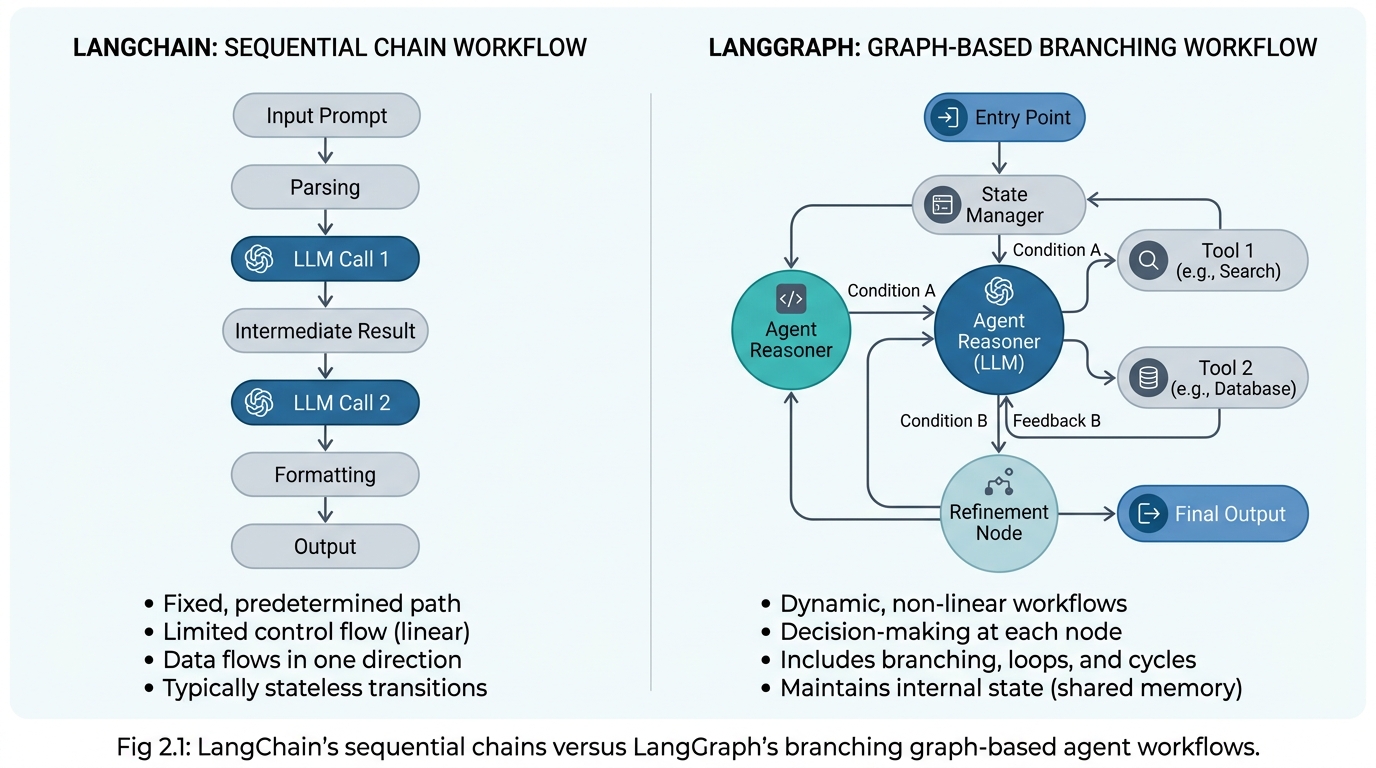
LangChain organizes AI application development around several key abstractions. Models provide a unified interface to interact with any language model — OpenAI, Anthropic, Google, or open-source alternatives — through a consistent API. Prompts manage template systems for constructing effective instructions with dynamic variable injection. Chains link multiple processing steps into sequential pipelines where the output of one step becomes the input of the next. Agents add decision-making capability, allowing the system to dynamically choose which tools and chains to invoke based on the current context. Memory modules manage conversation history and state persistence across interactions.
When to Use LangChain
LangChain excels for applications requiring rapid prototyping, straightforward agent implementations, and integration with diverse language models and tools. Its extensive ecosystem of pre-built integrations — covering vector databases, document loaders, API connectors, and output parsers — makes it the fastest path from concept to working prototype. Teams already familiar with Python will find LangChain’s patterns intuitive and well-documented.
Practical Example
A research assistant agent built with LangChain might chain together a web search tool, a document summarizer, a citation extractor, and a report formatter. The agent receives a research question, searches for relevant papers, extracts key findings, synthesizes them into a coherent summary, and formats the output with proper citations — all through a declarative chain definition that is readable and maintainable.
LangGraph: Stateful, Multi-Step Agent Workflows
LangGraph extends LangChain’s capabilities by introducing graph-based workflow orchestration specifically designed for complex agentic applications. While LangChain chains are inherently sequential, LangGraph enables branching logic, conditional execution, parallel processing, and cyclical workflows that are essential for sophisticated agent behavior.
Graph-Based Architecture
In LangGraph, workflows are defined as directed graphs where nodes represent processing steps and edges define the flow between them. Each node can be a language model call, a tool invocation, a conditional check, or a custom function. Edges can be conditional — routing execution to different nodes based on the output of the previous step. This graph structure naturally represents the branching, iterative nature of agentic reasoning.
State Management
LangGraph’s most significant contribution is its built-in state management system. Every workflow maintains a persistent state object that accumulates information as the agent progresses through its task. This state can include the current plan, intermediate results, error logs, tool outputs, and any application-specific data. State persistence enables agents to pause and resume workflows, implement human-in-the-loop approval steps, and recover gracefully from failures.
When to Use LangGraph
LangGraph is the framework of choice when building agents that require complex decision trees, multi-step reasoning with branching logic, human approval workflows, or long-running tasks that must maintain state across interruptions. It is particularly powerful for enterprise applications where workflow reliability and auditability are critical.
CrewAI: Multi-Agent Collaboration
While LangChain and LangGraph focus on single-agent architectures, CrewAI addresses a fundamentally different challenge: coordinating multiple specialized agents that work together as a team. This multi-agent approach mirrors how human organizations operate — with specialists collaborating to solve complex problems that no individual could handle alone.
The Crew Metaphor
CrewAI organizes agents into crews, where each agent has a defined role, expertise area, and set of tools. A content production crew might include a Researcher agent that gathers information, an Analyst agent that identifies key insights, a Writer agent that produces the content, and an Editor agent that refines the output. Each agent operates autonomously within its role while coordinating with other agents through structured communication protocols.
Task Delegation and Coordination
CrewAI implements sophisticated task delegation mechanisms. Tasks can be assigned sequentially (each agent works after the previous one finishes), hierarchically (a manager agent delegates to specialist agents), or collaboratively (multiple agents work simultaneously and merge their outputs). The framework handles inter-agent communication, conflict resolution, and output synthesis automatically.
When to Use CrewAI
CrewAI excels when problems naturally decompose into distinct specialist roles, when the quality of output benefits from multiple perspectives, or when the complexity of the task exceeds what a single agent can reliably handle. Content creation pipelines, research teams, code review systems, and strategic analysis workflows are all strong candidates for multi-agent architectures.
AutoGen: Conversational Agent Teams
Developed by Microsoft Research, AutoGen takes a conversation-centric approach to multi-agent systems. Rather than defining rigid workflows, AutoGen creates agents that interact through natural language conversations, debating, refining, and building upon each other’s contributions.
Conversation-Driven Architecture
AutoGen agents communicate by exchanging messages in a shared conversation thread. This conversational approach enables emergent behaviors — agents can challenge each other’s reasoning, request clarification, propose alternatives, and iteratively improve solutions through dialogue. The framework supports both fully autonomous conversations and human-in-the-loop patterns where a human participant guides the agent team.
Code Execution and Validation
AutoGen includes built-in code execution capabilities, making it particularly powerful for software development workflows. An architect agent can design a solution, a coder agent can implement it, an executor agent can run the code, and a reviewer agent can analyze the output — all through natural conversation. Failed code is automatically debugged through follow-up conversation turns.
No-Code Agentic Platforms: n8n and Visual Builders
Not every agentic AI application requires custom code. Platforms like n8n, Make, and Zapier have introduced agentic AI capabilities that enable non-programmers to build sophisticated automated workflows with AI decision-making at their core.
Visual Workflow Design
n8n provides a visual canvas where users connect nodes representing different services and actions. AI agent nodes can make decisions, process documents, classify inputs, generate responses, and route workflows based on intelligent analysis. This visual approach makes agentic AI accessible to business analysts, operations managers, and domain experts who understand their workflows deeply but may not write code.
When to Use No-Code Platforms
No-code platforms are ideal for business process automation, customer support workflows, data processing pipelines, and internal tool creation. They enable rapid deployment and iteration without engineering overhead. However, they trade customization depth for accessibility — complex agent behaviors may require custom code that visual builders cannot express.
Choosing the Right Framework
Framework selection should be driven by four factors: the complexity of agent behavior required, the team’s technical capabilities, the need for multi-agent collaboration, and production deployment requirements.
For simple agent applications with straightforward tool use, LangChain provides the fastest path to production. For complex workflows with branching logic and state management, LangGraph offers the necessary architectural sophistication. For problems requiring multiple specialist perspectives, CrewAI or AutoGen enable multi-agent collaboration. For business users seeking rapid automation without coding, n8n and similar platforms deliver immediate value.
The most effective teams often combine frameworks — using LangGraph for core agent logic, CrewAI for multi-agent coordination, and n8n for integration with business systems. This layered approach maximizes the strengths of each framework while maintaining overall system coherence.
Previous Module: Foundations of Agentic AI | Next Module: RAG, Memory, and Advanced Architectures →