Professional Certificate Course
Agentic AI Mastery
Build Intelligent AI Agents That Think, Plan, and Execute — From Foundations to Production
By Dr. Ananjan Maiti | AI Researcher & Educator | 11+ Years in AI/ML Research
4
Modules
40+
Research References
6
Frameworks Covered
$100B+
Market by 2035
The Agentic AI Revolution Is Here
The AI industry is undergoing its most significant transformation since deep learning. We are moving beyond chatbots and content generators into the era of Agentic AI — intelligent systems that autonomously plan tasks, make decisions, use external tools, and execute complex workflows with minimal human intervention. According to recent industry analysis, the global agentic AI market is projected to surpass $100 billion within the next decade, with adoption accelerating across healthcare, finance, legal, education, cybersecurity, and enterprise operations.
This is not incremental improvement — it is a paradigm shift. Organizations worldwide are racing to adopt agentic architectures, and the demand for professionals who can design, build, and deploy AI agents has never been higher. Research by McKinsey Global Institute indicates that AI-powered automation could generate $13 trillion in additional global economic activity by 2030, with agentic systems playing a central role in this transformation.
Why This Course Stands Apart
This course is grounded in peer-reviewed research from leading AI laboratories and institutions worldwide. Every concept, framework, and architectural pattern covered in this curriculum is supported by published academic work, ensuring you learn not just how to build AI agents, but why specific approaches work, backed by rigorous empirical evidence.
| Feature | This Course | Typical AI Courses |
|---|---|---|
| Focus Area | Agentic AI (goal-driven autonomous systems) | Prompt engineering or model training |
| Frameworks Covered | LangChain, LangGraph, CrewAI, AutoGen, n8n, MCP | 1-2 frameworks at most |
| Research Foundation | 40+ peer-reviewed citations | Minimal or none |
| Production Deployment | Full module on guardrails, MCP, evaluation | Rarely covered |
| Multi-Agent Systems | Dedicated coverage with CrewAI and AutoGen | Not covered |
| RAG Architectures | Basic, Agentic, and Vectorless RAG | Basic only |
| Instructor Credentials | PhD, 11+ years research, published author | Varies widely |
Complete Course Curriculum
Module 1: Foundations of Agentic AI
Understand the evolution from traditional AI through large language models to agentic systems. Master the core concepts of autonomy, goal-driven behavior, planning, memory, tool use, and the agentic loop. Study the ReAct framework (Yao et al., 2023), chain-of-thought reasoning (Wei et al., 2022), and how modern AI agents decompose complex problems into executable steps. Explore the taxonomy of agent architectures from reactive systems to fully autonomous goal-seeking agents.
→ Read Full Module: Foundations of Agentic AI
Module 2: Frameworks and Tools for Building AI Agents
Dive deep into the leading agentic AI frameworks — LangChain for composable chains, LangGraph for stateful multi-step workflows, CrewAI for multi-agent collaboration, AutoGen for conversational agent teams, and n8n for no-code agentic automation. Compare architectures, benchmark performance, and select the right framework for every use case. Study the MRKL architecture (Karpas et al., 2022) and Toolformer paradigm (Schick et al., 2023).
→ Read Full Module: Frameworks and Tools
Module 3: RAG, Memory Systems, and Advanced Architectures
Master Retrieval-Augmented Generation from the foundational work of Lewis et al. (2020) through agentic RAG with dynamic retrieval strategies. Implement short-term and long-term memory systems inspired by MemGPT (Packer et al., 2023). Learn planning architectures including Tree of Thoughts (Yao et al., 2023), self-reflection through Reflexion (Shinn et al., 2023), and iterative refinement. Explore vectorless RAG and hybrid retrieval methods.
→ Read Full Module: RAG, Memory, and Architectures
Module 4: Production-Ready AI Agents
Deploy AI agents in production environments with the Model Context Protocol for standardized tool integration, implement guardrails using frameworks like NeMo Guardrails and Constitutional AI principles (Bai et al., 2022). Build evaluation pipelines using RAGAS (Es et al., 2023) and custom metrics. Design enterprise architectures with monitoring, logging, human-in-the-loop oversight, and multi-agent orchestration at scale.
→ Read Full Module: Production Deployment
Industry Demand and Career Impact
| Metric | Data |
|---|---|
| Global Agentic AI Market (projected) | $100B+ by 2035 |
| AI Agent Engineer salary range | $150K–$350K (US market) |
| Workers with AI skills earn more | 56% premium over non-AI peers |
| Companies with AI training programs | Only 12% of workforce trained |
| Top hiring sectors | Healthcare, Finance, Legal, Cybersecurity, SaaS |
| AI economic impact by 2030 | $13 trillion (McKinsey estimate) |
Who Should Enroll
- Software Developers — Build intelligent automation beyond traditional scripts and rules
- Data Scientists and ML Engineers — Expand from model training to autonomous agent architectures
- Technical Leaders and CTOs — Design enterprise AI strategies with production-grade agent systems
- Researchers and Academics — Explore the frontier of autonomous AI with rigorous academic grounding
- Entrepreneurs and AI Consultants — Build and sell AI agent solutions to businesses
- Career Changers — Enter the highest-demand area of AI with comprehensive, structured training
Prerequisites
Basic familiarity with Python programming and a conceptual understanding of large language models is recommended. No prior experience with AI agents or specific frameworks is required — the course starts from first principles and builds progressively to advanced production architectures.
Learning Outcomes
| Skill Category | Specific Competencies |
|---|---|
| Conceptual Foundations | Agentic loop, ReAct pattern, autonomy spectrum, agent taxonomies |
| Framework Proficiency | LangChain, LangGraph, CrewAI, AutoGen, n8n |
| Retrieval Systems | Vector RAG, Agentic RAG, Vectorless RAG, hybrid retrieval |
| Memory Architecture | Short-term, long-term, episodic, semantic memory systems |
| Production Engineering | MCP integration, guardrails, evaluation pipelines, monitoring |
| Enterprise Architecture | Multi-agent orchestration, human-in-the-loop, governance |
About the Instructor
Dr. Ananjan Maiti brings over 11 years of research experience in artificial intelligence, deep learning, and computer vision. With published research in leading international journals, patents in AI innovation, and extensive teaching experience at the university level, Dr. Maiti combines rigorous academic depth with practical industry perspective. His research spans neural network architectures, intelligent systems, and applied AI — providing students with insights that bridge the gap between theoretical research and production reality. As both an active researcher and practitioner, Dr. Maiti ensures that course content reflects the latest developments in agentic AI.
Ready to Master Agentic AI?
Join professionals and researchers building the next generation of intelligent AI systems.
Certificate of completion included
Frequently Asked Questions
How long does the course take to complete?
The course is designed for 4 to 6 weeks at 5 to 8 hours per week. Each module includes comprehensive reading material, practical exercises, and project-based assessments. Self-paced learners can progress according to their schedule.
Do I need expensive hardware or cloud resources?
Most exercises use free-tier cloud services and open-source models. The course emphasizes practical approaches within typical resource constraints, with guidance on scaling for production deployments.
Will I build real AI agents?
Yes. Each module includes hands-on projects — from simple conversational agents to multi-agent systems with memory, tool use, and retrieval capabilities. You will complete the course with a portfolio of working AI agent implementations.
How is this different from other AI courses?
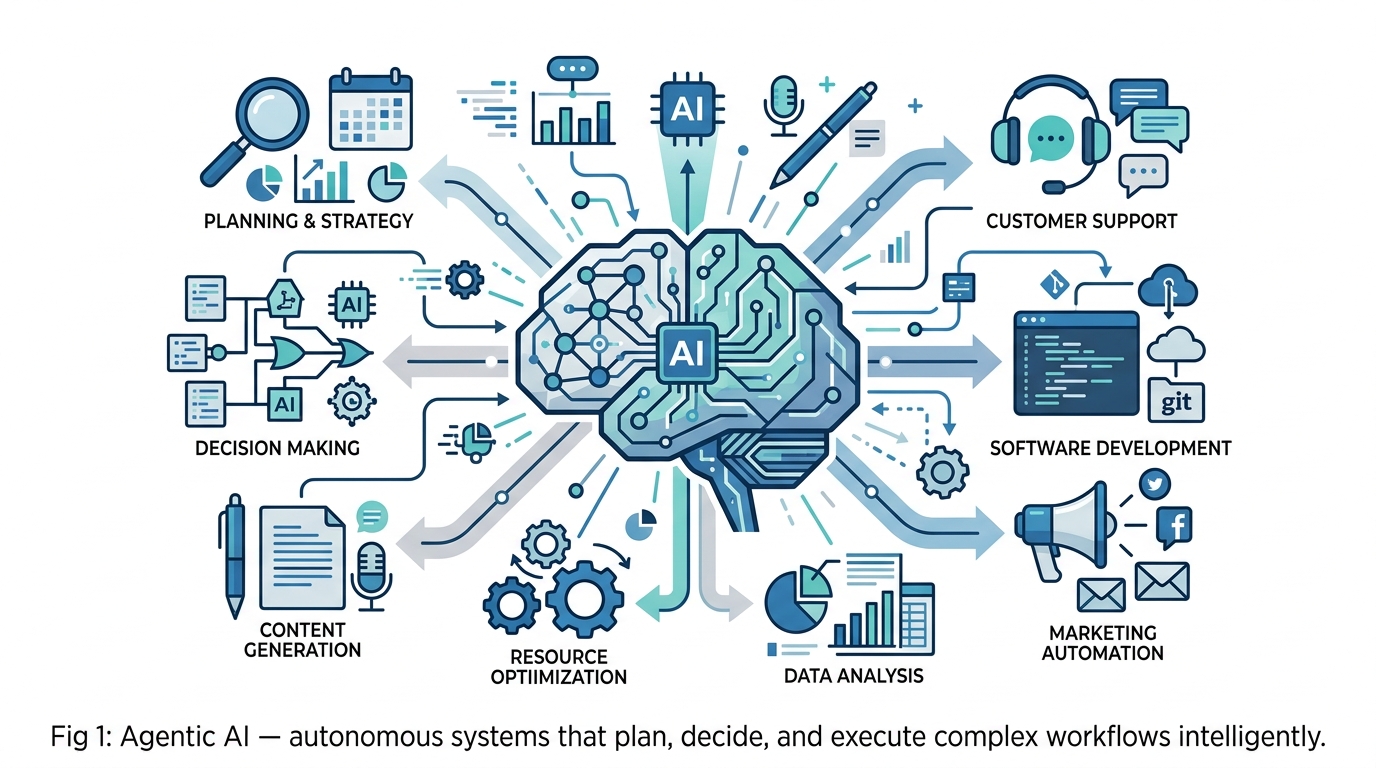
Most AI courses cover prompt engineering or model fine-tuning. This course focuses specifically on agentic AI — autonomous systems that plan, decide, and execute. The curriculum includes MCP integration, agentic RAG, multi-agent collaboration, guardrails, and evaluation frameworks that are rarely covered elsewhere. Every concept is grounded in peer-reviewed research.
Is there a certificate?
Yes. Upon successful completion of all four modules and associated assessments, participants receive a professional certificate from Dr. Ananjan Maiti’s AI Research Lab.
Foundational References
- Yao, S., Zhao, J., Yu, D., et al. (2023). ReAct: Synergizing Reasoning and Acting in Language Models. ICLR 2023.
- Wei, J., Wang, X., Schuurmans, D., et al. (2022). Chain-of-Thought Prompting Elicits Reasoning in Large Language Models. NeurIPS 2022.
- Lewis, P., Perez, E., Piktus, A., et al. (2020). Retrieval-Augmented Generation for Knowledge-Intensive NLP Tasks. NeurIPS 2020.
- Schick, T., Dwivedi-Yu, J., Dessì, R., et al. (2023). Toolformer: Language Models Can Teach Themselves to Use Tools. NeurIPS 2023.
- Park, J.S., O’Brien, J.C., Cai, C.J., et al. (2023). Generative Agents: Interactive Simulacra of Human Behavior. UIST 2023.
- Yao, S., Yu, D., Zhao, J., et al. (2023). Tree of Thoughts: Deliberate Problem Solving with Large Language Models. NeurIPS 2023.
- Karpas, E., Abend, O., Belinkov, Y., et al. (2022). MRKL Systems: A Modular, Neuro-Symbolic Architecture. arXiv:2205.00445.
- Shinn, N., Cassano, F., Labash, A., et al. (2023). Reflexion: Language Agents with Verbal Reinforcement Learning. NeurIPS 2023.
- Packer, C., Wooders, S., Lin, K., et al. (2023). MemGPT: Towards LLMs as Operating Systems. arXiv:2310.08560.
- Bai, Y., Kadavath, S., Kundu, S., et al. (2022). Constitutional AI: Harmlessness from AI Feedback. arXiv:2212.08073.